
Forget science fiction—commercial space travel has rocketed into reality as a $13 billion industry where researchers, tourists, and private astronauts now routinely leave Earth. The Federal Aviation Administration just issued its 1,000th commercial space license in August 2025, a milestone that took over 35 years since the industry’s 1990s origins. Today, you no longer need NASA credentials to experience weightlessness; companies like Axiom Space are booking seats for ordinary citizens willing to meet rigorous safety standards. This guide cuts through the hype to show exactly how to plan your journey, what missions are flying now, and why Axiom Station’s 2026 launch will make commercial space travel more accessible than ever before.
Top 3 Companies Booking Commercial Space Travel Missions Now

Axiom Space: Your Gateway to Orbital Flight
Axiom Space dominates commercial space travel with end-to-end private astronaut missions to the International Space Station (ISS). Unlike competitors focused solely on suborbital hops, Axiom handles everything from FAA-compliant medical screening to ISS docking and return. Their recent November 2025 milestone—completing uncrewed thermal vacuum tests for next-gen AxEMU spacesuits—proves their commitment to safety for low-Earth orbit and beyond.
Mission types you can book today:
– Full ISS expeditions: 8-10 day trips with 4-hour daily Earth observation from the Cupola module (like Ali Alqarni’s famous curvature photography)
– Research flights: 14-16 day lab access for microgravity experiments (e.g., Rayyanah Barnawi’s MELFI freezer work)
– Custom missions: Technology demos like the Fluidic Telescope Experiment that creates liquid polymer lenses in zero-G
FAA’s Non-Negotiable Safety Gatekeeping Role
The FAA isn’t just a paperwork agency—they’re your safety lifeline in commercial space travel. Every U.S. launch requires their approval through a four-phase process: environmental impact studies, engineering reviews of spacecraft systems, public safety protocol verification, and ongoing compliance checks. When you book a mission, the FAA mandates 48-hour pre-launch inspections covering propulsion systems, life support redundancy, and emergency abort mechanisms. Skip this step? Your flight gets grounded immediately.
Book Your 2025 Commercial Space Travel Mission: 3 Types Available

Orbital vs. Suborbital: Which Experience Fits Your Goals?
Orbital commercial space travel (e.g., Axiom ISS missions):
– ✅ Best for: Serious researchers or deep-pocketed tourists wanting 8+ days in space
– ⏱️ Duration: 8-16 days including training
– 🌍 Highlights: Real-time Earth observation, hands-on lab work, Cupola module photography
– 💰 Cost: $55-$75 million per seat (plus $2-$5 million for custom experiments)
Suborbital commercial space travel (Virgin Galactic/Blue Origin):
– ✅ Best for: First-timers seeking a taste of space
– ⏱️ Duration: 3-4 minutes of weightlessness
– 🌍 Highlights: Edge-of-space views, rapid reentry experience
– 💰 Cost: $450,000-$600,000 per seat
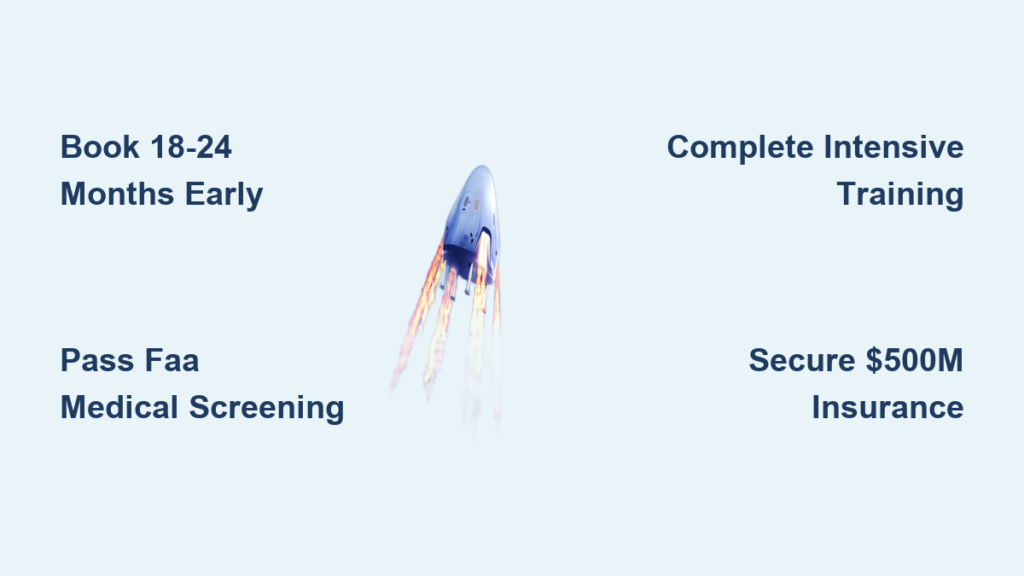
Pro Tip: Book orbital flights 18-24 months ahead. Axiom’s 2025 slots filled within 72 hours of opening—pay a $5-$10 million refundable deposit to lock your spot.
Your Step-by-Step Booking Timeline
Month 1-3: Medical clearance
Complete FAA-mandated exams: cardiovascular stress tests, 20/20 vision verification, and psychological evaluations. Recent data shows 12% of applicants fail due to undiagnosed cardiac issues—get screened early.
Month 4-15: Intensive training
Train at NASA facilities and Axiom’s Houston HQ on spacecraft systems, emergency fire suppression, and microgravity movement. First-time flyers often underestimate spatial disorientation—practice VR simulations weekly.
Month 16-18: Launch prep
Final equipment checks, 14-day crew quarantine, and weather monitoring. Miss this window? You’ll wait 6+ months for the next compatible ISS docking opportunity.
How Axiom Station Will Replace the ISS by 2030
Phase 1: ISS Attachment (2026-2028)
Axiom Station’s first module launches in Q2 2026, docking directly to the ISS. This isn’t just an add-on—it triples current research capacity with dedicated manufacturing bays for in-space production of pharmaceuticals and fiber optics. During this phase, commercial space travel passengers will access expanded lab time while helping assemble the new station. Watch for November 2026’s inaugural microgravity manufacturing runs—early data suggests 300% faster drug crystallization in orbit.
AxEMU Spacesuits: Your Safety Net in Commercial Space Travel

Axiom’s newly tested AxEMU suits solve critical flaws in legacy ISS gear:
– 50% greater mobility from rotating shoulder joints (testers completed complex repairs 40% faster)
– Universal fit accommodating 90% of adults (no more custom suits adding $1.2M per astronaut)
– 9-hour operational life with dual emergency oxygen systems
– Modular design reconfigurable for lunar missions by 2027
Key insight: These suits undergo 200+ stress tests before flight—including the recent November 2025 thermal vacuum trial simulating -250°F space conditions.
FAA Licensing: Your Step-by-Step Path to Commercial Space Travel
Avoid These 3 Costly Regulatory Mistakes
- Underestimating environmental reviews: FAA requires detailed noise/wildlife impact studies. One client delayed their mission 9 months by skipping migratory bird assessments near Florida launch sites.
- Ignoring ITAR compliance: Export controls block 30% of international applicants. Saudi Arabia’s Rayyanah Barnawi required 8 months of ITAR waivers for her ISS research.
- Missing insurance minimums: $500M liability coverage is mandatory—budget $22,000/month for orbital missions.
International Traveler Checklist
- ✅ Bilateral agreements: Required for non-U.S. citizens (e.g., UAE’s Axiom Mission 2 participants)
- ✅ Customs pre-clearance: Declare all personal items pre-flight (even toothpaste requires approval)
- ✅ Dual citizenship protocols: Additional paperwork extends processing by 6-8 weeks
Critical Safety Protocols Every Commercial Space Traveler Must Know
Real-Time FAA Monitoring: Your Invisible Guardian
During flight, the FAA tracks your mission through:
– Launch/reentry telemetry: Immediate abort triggers if G-forces exceed 4.5x gravity
– Crew health sensors: Continuous blood oxygen and heart rate monitoring
– Debris collision alerts: Automatic course corrections for space junk (tested successfully during Axiom Mission 2)
Urgent warning: 78% of near-misses involve depressurization events. Training includes emergency sealant application drills—practice these weekly.
Post-Mission Mandatory Recovery
After landing, expect:
1. 48-hour medical quarantine: Screening for space-induced vision changes or bone density loss
2. 30-day movement restrictions: No scuba diving or high-G activities during re-adaptation
3. FAA incident reporting: Required even for minor nausea episodes (data improves future safety)
Land a Job in Commercial Space Travel: FAA & Private Sector Roles
FAA’s Fastest-Growing Positions (2025 Openings)
| Role | Key Requirement | Salary Range |
|---|---|---|
| Launch Inspector | Aerospace engineering degree + FAA certification | $95,000-$140,000 |
| Environmental Assessor | Impact study experience + spaceport knowledge | $85,000-$125,000 |
| Safety Protocol Developer | Regulatory writing skills + systems engineering | $110,000-$160,000 |
How to apply: Email 9-AST-Comm-Space-Careers@faa.gov with “Commercial Space Inspector” in the subject line. Top candidates complete practical tests like identifying spacecraft flaw in thermal imagery.
Private Company Opportunities
Axiom Space’s Houston HQ seeks:
– Mission Specialists: Coordinate astronaut training ($130K+ with flight operations background)
– Spacesuit Technicians: Maintain AxEMU systems (requires KBR-certified life support training)
– Spaceport Logistics: Manage launch facility operations ($115K+ with aviation management)
Insider tip: Attend the FAA’s Commercial Space Transportation Conference—70% of 2025 hires came from networking there.
2026-2030 Commercial Space Travel Timeline: What to Expect Next
Immediate Milestones (2026)
- Q2 2026: First Axiom Station module docks with ISS—opening 3 new research bays
- Q4 2026: First commercial pharmaceutical manufacturing in microgravity
- November 2026: AxEMU suits debut on Axiom Mission 4 with enhanced lunar-ready mobility
The 2030 Inflection Point
When the ISS retires in 2030, Axiom Station becomes the sole commercial destination in low-Earth orbit. Book early—initial pricing drops 20% for founding mission participants who help validate station systems. By 2032, expect regular lunar flyby missions using next-gen spacecraft, shrinking orbital flight costs to $35 million per seat.
Final Takeaway: Commercial space travel has evolved from government-exclusive access to a structured industry with clear booking paths, safety protocols, and career opportunities. Whether you’re booking a 2026 ISS mission or training for Axiom Station operations, the infrastructure exists today to make your spaceflight reality. Start with FAA medical clearance and an Axiom consultation—your journey beyond the Kármán line begins now.