
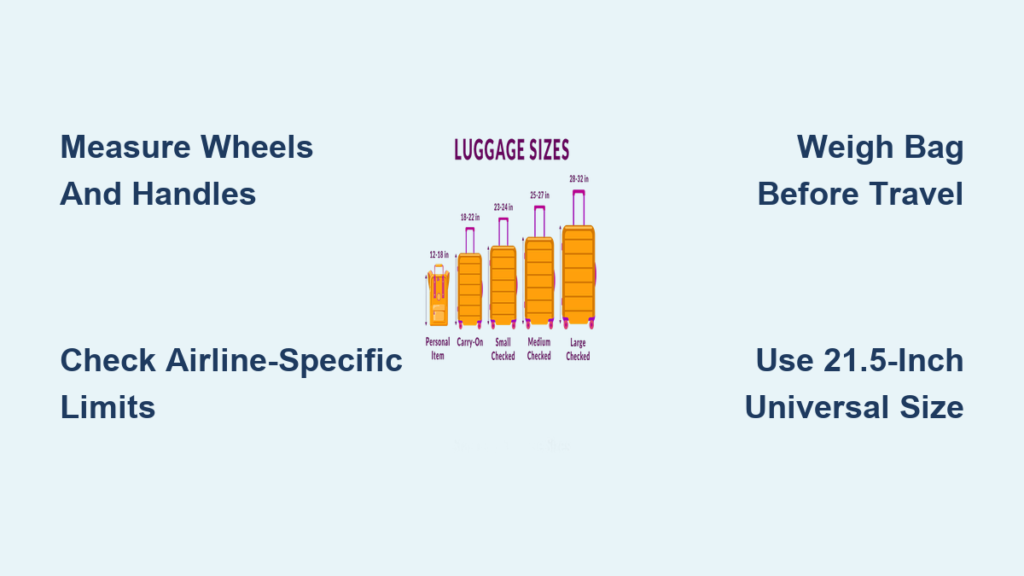
Packing your carry-on only to find it doesn’t fit the airline’s size requirements is every traveler’s nightmare. One passenger recently watched their perfectly packed bag get gate-checked at Aer Lingus because it exceeded the 18.5-inch length limit by just half an inch—costing them $35 in unexpected fees. With airline baggage policies varying dramatically between carriers, knowing the exact travel baggage size before you fly isn’t just helpful—it’s essential for avoiding costly surprises.
This guide breaks down every major airline’s carry-on restrictions, from the most restrictive 18.5-inch limits to generous 24-inch allowances, plus weight restrictions that range from no limits to strict 11-pound caps. You’ll learn which airlines require measurements including wheels and handles, how to pack for multiple carriers on connecting flights, and the universal size that works for virtually any airline worldwide.
Why Your 22-Inch Carry-On Might Get Gate-Checked
:max_bytes(150000):strip_icc()/TAL-illustrated-chart-CARRYSIZE0325-35ad53e34fe94833b370f432af602978.jpg)
Most travelers assume a “standard” 22-inch carry-on works universally, but this common misconception leads to thousands of gate-checked bags daily. The 22 x 14 x 9 inch (56 x 36 x 23 cm) framework serves as the baseline for American Airlines, Delta, United, JetBlue, and Alaska Airlines, yet nearly 30% of global carriers enforce significantly different requirements.
Aer Lingus’ 18.5-Inch Trap for Unprepared Travelers
Aer Lingus enforces the tightest restrictions globally at 18.5 x 13 x 8 inches with a strict 15-pound weight limit. This makes their allowance approximately 16% smaller than industry standards. If your bag exceeds these dimensions even slightly, you’ll face mandatory gate-checking and potential fees. Pro tip: Measure your packed bag with wheels extended and handle fully raised—Aer Lingus includes these in their restrictions.
Qatar Airways’ Shorter Length Requirement
Qatar Airways allows 20 x 15 x 10 inches with 15 pounds maximum, creating particular problems for travelers with standard 22-inch bags. The 2-inch shorter length restriction catches many passengers off guard during boarding. If you’re flying Qatar with a standard carry-on, consider removing non-essential items before security screening to avoid last-minute repacking at the gate.
Airlines That Allow 24-Inch Carry-Ons Without Weight Limits
Southwest’s Generous 24-Inch Policy Explained
Southwest Airlines provides the industry’s largest standard dimensions at 24 x 16 x 10 inches with no weight restrictions. This 20% larger capacity than standard allowances means you can comfortably pack heavier items like laptops, books, or souvenirs without worrying about weight. Critical note: Southwest measures bags using their own sizers at the gate—don’t rely solely on manufacturer specifications.
Spirit Airlines’ Extra Width Advantage
Spirit offers 22 x 18 x 10 inches with no weight limits, giving you 4 extra inches of width compared to standard 14-inch restrictions. This extra space is perfect for bulky items like winter coats or duty-free purchases. If you frequently fly Spirit, consider a bag specifically designed for their wider requirement to maximize packing capacity.
Regional Travel Baggage Size Patterns You Must Know
North American Airlines’ No-Weight-Limit Advantage
Major U.S. and Canadian carriers generally offer the most permissive policies with standard 22 x 14 x 9 inch dimensions and no weight restrictions. However, Air Canada adds a practical limitation—your bag must be light enough to lift into overhead compartments without assistance. For most travelers, this creates an unofficial 25-30 pound limit based on individual strength.
European Airlines’ Depth Restrictions
European carriers show significant diversity in travel baggage size requirements:
– British Airways: 22 x 18 x 10 inches (generous width)
– Ryanair: 21.6 x 15.7 x 8 inches (restrictive 8-inch depth)
– Lufthansa: 21.6 x 15.7 x 9 inches (standard European)
Budget airlines like Ryanair enforce particularly strict depth measurements that catch many travelers with standard rectangular bags. Warning: Ryanair’s sizers at European airports are notoriously strict—measure your packed bag before arriving at the airport.
Asian Airlines’ Strict Weight Limits
Asian carriers maintain consistent 22-inch length requirements but often implement surprisingly strict weight restrictions:
– Singapore Airlines: 22 x 15 x 8 inches with 11-pound limit
– Korean Air: 22 x 15.7 x 8 inches with 26-pound allowance
– Japan Airlines: 21.6 x 15.7 x 10 inches with 22-pound limit
When flying Asian carriers, prioritize lightweight packing materials and weigh your bag before departure. Many travelers get surprised by Asian airlines’ weight enforcement, especially when returning home with souvenirs.
Weight Restrictions That Cost Travelers Thousands Daily
Airlines With No Weight Limits
These carriers focus solely on dimensions, giving you freedom to pack heavier items:
– All major North American airlines (American, Delta, United)
– Southwest, Spirit, and Allegiant
– EasyJet (both standard and guaranteed sizes)
– WestJet
If you frequently travel with heavy electronics or business materials, prioritize airlines from this list when booking flights. Time-saving tip: Pack heavier items at the bottom of your bag where they’re less likely to shift during security screening.
Airlines With Strict 11-Pound Weight Caps
These carriers enforce challenging low-weight limits that surprise many travelers:
– Air China: 11 pounds
– China Southern Airlines: 11 pounds
– Thomas Cook: 11 pounds
– Cebu Pacific Air: 11 pounds
For these airlines, consider packing a lightweight toiletry kit and wearing your bulkiest clothing during travel. Many passengers exceed these limits by just a few pounds with standard packing—weigh your bag at home to avoid gate-checking fees.
EasyJet’s Dual Size System Decoded

EasyJet uniquely operates a two-tier carry-on system that confuses many travelers. Their standard size (22 x 18 x 10 inches) fits most overhead bins but may get gate-checked on full flights. Their “guaranteed” size (19.6 x 15.7 x 7.8 inches) ensures overhead bin space but severely limits packing capacity.
Strategic advice: If you’re booking EasyJet during peak travel seasons, opt for the guaranteed size to avoid having your bag gate-checked. For off-peak travel, the standard size provides better packing flexibility without significant risk.
Universal Travel Baggage Size That Works Everywhere
The 21.5-Inch Compatibility Solution
For travelers flying multiple airlines or booking connecting flights on different carriers, a bag measuring 21.5 x 14 x 8 inches or smaller accommodates even the most restrictive international carriers while fitting within weight limitations. This size works for Aer Lingus’ tight requirements while still providing reasonable capacity for longer trips.
Measurement Techniques Airlines Don’t Tell You
When verifying your travel baggage size:
– Always measure including wheels and handles—airlines include these in restrictions
– Use soft-sided bags for flexibility with dimensional variations
– Test your packed bag against airline sizers before departure (many airports have them near security)
– Critical warning: Don’t rely on manufacturer “22-inch” claims—measure your actual packed bag
Final Travel Baggage Size Verification Checklist
Before your next flight, complete these essential steps to avoid gate-checking:
1. Verify current policies—airline restrictions change frequently (check 48 hours before travel)
2. Consider the smallest airline on your itinerary when choosing luggage
3. Measure your packed bag rather than relying on empty specifications
4. Weigh your bag at home if flying airlines with strict weight limits
5. Bring a collapsible bag as backup for overflow items
Remember: gate-checking isn’t just inconvenient—it often incurs additional fees that can exceed the cost of checking a bag initially. A 21-inch soft-sided bag weighing under 15 pounds accommodates virtually any airline worldwide while keeping you within even the strictest travel baggage size requirements.
For maximum flexibility across global carriers, prioritize width over height in your luggage selection—most restrictive airlines limit width and depth more severely than height. This single adjustment prevents more gate-checking incidents than any other packing strategy.