
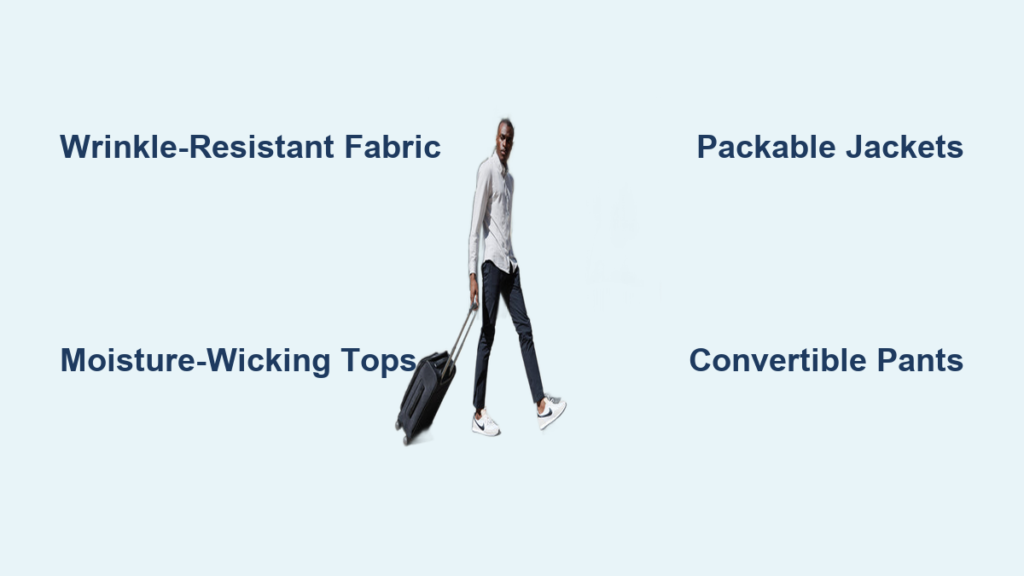
You’ve packed your suitcase only to discover your best dress shirt looks like it survived a tornado, your “quick-drying” shorts took three days to dry in humid conditions, and you’re stuck wearing the same outfit twice before laundry access. This frustrating scenario happens to countless travelers who haven’t discovered the right best travel clothes for men. Modern travel clothing has evolved beyond basic performance claims to deliver genuine solutions that transform how you experience every journey—whether you’re navigating airport lounges or exploring remote destinations.
The difference between ordinary clothing and truly effective travel gear lies in specialized fabric technology and purposeful design. Today’s best travel clothes for men combine moisture-wicking capabilities, wrinkle resistance, and odor control to create a streamlined wardrobe that performs across diverse environments. Instead of lugging around multiple outfits, you can confidently pack lighter while maintaining comfort and professionalism. This guide reveals exactly what separates functional travel clothing from marketing hype, helping you build a versatile travel wardrobe that adapts to your itinerary rather than restricting it.
Prioritize Performance Fabric Technologies That Actually Work

Stop settling for “travel-friendly” clothing that fails when you need it most. The foundation of any effective travel wardrobe lies in understanding which fabrics deliver genuine performance benefits rather than relying on marketing buzzwords. When selecting the best travel clothes for men, focus on materials engineered for real-world travel challenges rather than general-purpose activewear.
Polyester-based fabrics dominate travel clothing for good reason—they resist wrinkles, dry quickly, and withstand repeated packing without losing shape. Modern microfibers have eliminated the plasticky feel of early synthetics, now offering soft textures that rival natural fibers. Quality polyester absorbs less than 1% of its weight in water compared to cotton’s 2,500% absorption rate, meaning your shirt dries overnight instead of taking days in humid conditions. Look for moisture-wicking treatments that actively move perspiration toward the fabric’s surface for rapid evaporation, essential when navigating varied climates or staying active during your travels.
Nylon excels in durability for travel pants and shorts that endure repeated wear and the inevitable abuse of travel. Its smooth surface resists snagging from luggage zippers and seatbelt buckles. Pay attention to denier ratings—lower numbers (20-40D) create lightweight packable pieces, while higher ratings (70-500D) deliver rugged durability. Most quality travel garments use mid-range ratings around 40-70D for the best balance between weight and toughness.
Merino wool remains unmatched for temperature regulation and odor resistance. Unlike traditional wool, Merino fibers measure 17-24 microns in diameter—fine enough to feel soft against skin without itching. Its natural antimicrobial properties let you wear the same garment multiple days between washings, crucial for extended trips. Laboratory testing confirms Merino wool garments can be worn consecutively for days without developing noticeable odor, a performance metric no synthetic fabric has definitively replicated.
Choose Travel Tops That Work Harder Than You Do
Your top selection determines how put-together you appear across diverse travel scenarios while minimizing luggage volume. The best travel clothes for men include versatile tops that serve multiple contexts without requiring constant outfit changes—a single quality button-down that works for client dinners and daytime sightseeing delivers more value than two specialized garments.
Quality travel button-down shirts combine wrinkle-resistant fabric with functional design details that enhance travel convenience. Prioritize features including chest pockets with secure closures, button-down collars that maintain structure without requiring ties, and back vents that increase range of motion during long travel days. Modern travel button-downs often incorporate subtle technical features like hidden buttons that prevent gapping and sunglass-cleaning microfiber patches. Select versatile neutrals—navy, white, light blue, charcoal—that coordinate with multiple bottom options and transition smoothly between casual and formal contexts.
Performance t-shirts differ significantly from everyday cotton equivalents through moisture-wicking treatments, antimicrobial properties, and enhanced durability. These garments function as base layers, standalone pieces for casual exploration, and foundational elements for layered outfits. Technical t-shirts feature streamlined silhouettes that reduce bulk under other garments while preventing bunching during physical activity—essential when you’re walking through airports or hiking to cultural sites.
Polo shirts occupy the perfect middle ground between casual and formal. Travel-specific polos often incorporate collar stays that maintain crisp appearance, hidden button plackets that eliminate gap issues, and reinforced shoulder seams. Performance fabric options include moisture-wicking piqués and antimicrobial-treated cottons designed for packable convenience.
Select Bottoms That Handle Every Travel Scenario

Your choice of pants or shorts determines comfort during long travel days, adaptability to activities, and professional appearance when unexpected meetings arise. The best travel clothes for men include bottoms that balance durability with packability, incorporating features that enhance versatility while maintaining a polished silhouette.
Multiple pockets remain a personal preference—some travelers prioritize secure storage options while others prefer streamlined silhouettes. Quality travel pants typically offer at least four pockets: two hand pockets, a coin pocket, and a zippered rear pocket. The rise and waist configuration significantly impacts comfort during extended wear—mid-rise options provide coverage during sitting without requiring constant adjustment, while articulated knees and gusseted crotches enhance mobility.
Convertible pants offering zip-off legs provide dual functionality as pants and shorts, reducing luggage volume for variable weather destinations. Quality convertibles feature zippers that lie flat when closed and legs that can be removed without removing footwear. The length transition typically converts a 32-inch inseam pant to a 10-12 inch inseam short—suitable for warm weather but potentially limiting for those preferring longer shorts.
Pack Smart Layers That Save Luggage Space
Packable jackets have become essential travel items, providing warmth and weather protection without consuming significant luggage volume. The best travel clothes for men include layers that compress to roughly the size of a water bottle, enabling storage in carry-on bags or even large jacket pockets.
Down insulation offers superior warmth-to-weight ratio but loses insulating capability when wet, while synthetic alternatives provide reliable performance in damp conditions. Evaluate technical specifications including fill weight, water resistance ratings, and compressed dimensions. Hood configuration significantly impacts versatility—removable or stowable hoods enable adaptation between weather conditions.
Softshell jackets provide wind resistance and light weather protection in a highly breathable package. The brushed-fleece inner surfaces provide comfortable skin contact and additional insulation, while the tight outer weave blocks wind. These characteristics make softshells ideal for active travel applications where temperature regulation matters more than complete weatherproofing.
Build Your Perfect Capsule Wardrobe

Constructing an effective travel wardrobe begins with analyzing trip requirements: destination climate, planned activities, duration, and available laundry facilities. A systematic approach involves listing all planned activities, grouping outfits by context, and selecting pieces that serve multiple purposes.
The core travel wardrobe typically includes:
– Three to five tops (mixing button-downs and t-shirts based on trip formality)
– Two to three bottoms (coordinating colors enabling multiple combinations)
– One to two outer layers (packable jacket plus potentially a warmer layer)
– Seven sets of underwear and socks (enabling one-week rotation without laundry)
This foundation adapts based on trip specifics—adding base layers for cold destinations, swimwear for beach trips, or formal wear for business requirements. For extended travel, the one-week rule—packing clothing sufficient for one week between laundry opportunities—provides a practical guideline, though hand-washing capability extends effective wardrobe life.
Maintain Your Travel Clothes for Maximum Longevity
Proper care significantly extends the life of travel clothing, protecting your investment and ensuring consistent performance across trips. Most technical fabrics launder effectively in warm water with mild detergent, though specific care instructions vary by garment. Critical maintenance tips:
- Avoid fabric softeners—they destroy wicking treatments and water resistance
- Zip closures before washing to prevent hardware damage
- Air dry instead of using high heat, which damages synthetic fibers over time
- Treat stains immediately with travel-friendly stain removal pens
- Store between trips in breathable garment bags to prevent mildew
Immediate stain treatment significantly improves removal success. For oil-based stains, apply dish soap before washing; for protein-based stains like blood, use cold water soaks (heat sets protein stains); for hard water mineral deposits, add white vinegar to the rinse cycle.
Invest Wisely in Your Travel Wardrobe
The value proposition for premium travel clothing depends heavily on usage patterns. A quality shirt that lasts five years of regular travel represents better value than a budget option requiring annual replacement. Smart investment considerations:
- Warranty coverage provides additional value—premium brands often offer repair services
- Common selection errors include over-prioritizing single-purpose garments and selecting based on fashion rather than function
- Test mobility and comfort before purchase—garments that appear suitable in fitting rooms may prove uncomfortable during extended travel
Building your travel wardrobe is an iterative process that evolves through experience. Start with versatile core pieces that work across multiple trip types, then add specialized items as specific travel patterns emerge. This approach prevents expensive mistakes while gradually building a wardrobe that genuinely serves your travel style.
Final Tip: The best travel clothes for men aren’t about having the most expensive gear—they’re about selecting versatile pieces that solve real travel problems. Focus on fabric performance, strategic versatility, and thoughtful design rather than brand names or marketing hype. When you pack clothing engineered for actual travel challenges, you’ll spend less time worrying about your wardrobe and more time enjoying your journey.