
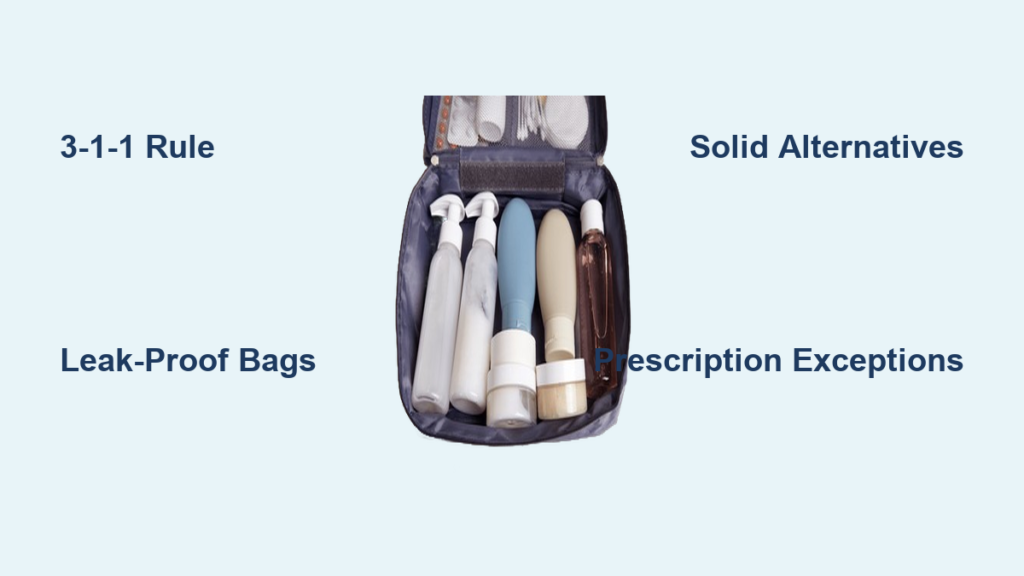
That sinking feeling when the TSA agent confiscates your $40 moisturizer moments before your flight is enough to ruin any vacation. You’ve meticulously planned your trip, only to have airport security turn your essential toiletries into landfill. The good news? Packing toiletries for air travel follows predictable rules that anyone can master—no expensive travel sets required. This guide reveals exactly how to pack toiletries that breeze through security while keeping your skincare routine intact. Whether you’re a business traveler needing professional grooming or a minimalist backpacker, you’ll discover practical systems that prevent leaks, maximize space, and keep your favorite products within reach.
Decoding TSA’s 3-1-1 Rule for Toiletries
The 3-1-1 rule isn’t arbitrary—it’s designed to balance security with traveler convenience. Your carry-on liquids must fit three specific criteria: containers under 3.4 ounces (100ml), all packed in one clear quart-sized bag, with only one bag per passenger. This applies to anything that flows, spreads, or squirts—including surprising items like mascara and lip gloss.
What Actually Counts as a Liquid for Air Travel
TSA considers any substance that can spill or spread as a liquid, including:
– Toothpaste and hair gel (even if they seem solid)
– Sunscreen creams and lotions (but not solid sticks)
– Liquid makeup foundations (powders and pressed products sail through)
– Hairspray and aerosol deodorants (stick deodorant avoids restrictions)
Mistake to avoid: Assuming “travel-sized” automatically means TSA-compliant. Always check the milliliter marking—many “travel” bottles exceed 100ml.
Smart Exceptions That Save Your Skincare Routine
Prescription medications bypass size limits when declared at security—just keep them in original labeled containers. Through 2025, you can carry up to 12 ounces of hand sanitizer in your quart bag, a game-changer for germ-conscious travelers. Baby formula, breast milk, and liquid medications also skip the 3-1-1 rule but require separate declaration. For everything else? Stick to the quart bag system or move full-size bottles to checked luggage where containers up to 18 ounces are allowed (with a 68-ounce total limit per person).
Strategic Pre-Packing Assessment for Your Trip
Start 72 hours before departure by laying out every toiletry you’d normally use. Now eliminate ruthlessly—most travelers need only 40% of what they initially consider essential. This isn’t about deprivation; it’s about strategic selection based on actual needs.
Trip Duration Determines Your Packing Strategy
For weekend trips (1-3 days): Skip the full routine. A solid shampoo bar replaces 8 ounces of liquid shampoo while lasting months. Pair it with toothpaste tablets (10 tablets = 1 ounce of paste) and a solid deodorant stick. Hotel amenities typically cover the rest.
For week-long trips: Calculate precise amounts. Two daily dabs of moisturizer using a pea-sized amount equals exactly 0.7 ounces for 7 days—perfect for a 1-ounce jar. Decant only what you’ll use to avoid wasted space and potential leaks.
Pro tip: Call your hotel to confirm provided amenities. Many upscale chains supply quality shampoo, conditioner, and body wash—freeing up quart bag space for your specialty products.
Leak-Proof Container Systems That Survive Air Travel

Your quart bag choice makes or breaks the experience. Ditch flimsy zip-top bags for reusable silicone TSA bags with sturdy double zippers—they stand upright during security screening and survive multiple trips. Look for models with flat bottoms to prevent tipping.
Container Types That Prevent Mid-Flight Disasters
For thick products (shampoo, conditioner): Flexible silicone squeeze bottles let you extract every drop while resisting pressure-related cracks. Fill them completely to minimize air expansion that causes leaks.
For precise dispensing (serums, oils): Hard plastic bottles with droppers work best. Before sealing, place plastic wrap over the opening—this creates an airtight barrier against pressure changes. Always label containers with waterproof stickers; anonymous bottles get confiscated.
Critical move: Double-bag each liquid container in snack-sized bags before adding to your quart bag. This contains leaks while speeding up security screening when you present a tidy, organized bag.
Category-Specific Packing Solutions That Work
Hair Care Without Hassles
Shampoo and conditioner: Solid bars eliminate liquid restrictions entirely—one Ethique bar replaces three 8-ounce bottles. If you must pack liquids, decant into 3-ounce silicone bottles marked “SHAMPOO” in bold letters. For styling, dry shampoo powder passes security freely while traveling more compactly than aerosols.
Emergency fix: Forgot dry shampoo? Pack a travel-sized cornstarch container—just a teaspoon refreshes oily roots between washes.
Skincare That Survives Security Screening
Cleansing: Makeup remover wipes bypass liquid rules completely. One wipe replaces 2 ounces of liquid cleanser. For oil cleansers, use 1-ounce dropper bottles filled to the brim—this prevents air expansion leaks during flight.
Moisturizing: Sunscreen sticks avoid restrictions while providing better coverage than liquids. Face moisturizer travels perfectly in 1-ounce jars (two weeks’ worth for most users). Eye cream? Decant into contact lens cases—each holds enough for 10 applications.
Oral Care That Fits Your Quart Bag
Toothbrush: Choose a folding model with a rigid case—cheap versions snap mid-trip. Electric toothbrush users: pack the travel case fully charged and verify voltage compatibility for your destination.
Toothpaste: Tablets eliminate leak risks entirely. Traditional paste users: flatten tubes completely before sealing and tape the cap with electrical tape. Never pack toothpaste above 3.4 ounces in carry-ons.
Medication and Special Needs Protocol
:max_bytes(150000):strip_icc()/taking-prescription-drugs-through-airport-security-2972595-v7-5b3b837046e0fb0037c41f94.png)
Prescription medications travel outside the 3-1-1 rule but require strategy. Keep pills in original labeled containers—pharmacy printouts beat handwritten notes during security checks. Pack 25% extra for unexpected delays; TSA confiscates unlabeled medications even when medically necessary.
For over-the-counter items, create a mini first-aid kit using pill organizers. Fill seven-day containers with pain relievers and antacids—this eliminates multiple bottles while ensuring essentials. Medicated patches replace creams for motion sickness or allergies, bypassing liquid restrictions entirely.
International Travel Toiletry Adjustments
:max_bytes(150000):strip_icc()/liquids-on-a-plane-4046937-FINAL-5ba3d35d4cedfd002506643d.png)
Destination matters more than you think. Japan bans pseudoephedrine (found in many cold medicines), while Australia restricts certain plant-based ingredients common in American products. Research your destination’s prohibited items 48 hours pre-trip—customs websites list banned substances.
Climate changes demand product adjustments. Pack lighter moisturizers for humid destinations; dry climates require richer formulas. Always check voltage requirements for electric items—many hotels provide universal adapters, but battery-operated alternatives prevent charging disasters.
Last-Minute Security Screening Checklist
24 hours pre-flight: Test every container by squeezing gently—leaky bottles get replaced immediately. Confirm your quart bag measures under 7″x8″ (TSA rejects oversized bags). Pack prescription meds in a separate clear bag for easy declaration.
At security: Place your quart bag in an outer jacket pocket for instant access. Keep medications physically separate from other liquids. If TSA questions an item, calmly explain its purpose—”This is my prescription acne treatment” works better than “It’s medicine.”
Post-security: Buy water and full-size sunscreens after clearing security. Duty-free liquids must stay sealed in special bags until your final destination—keep receipts visible for customs checks.
Mastering how to pack toiletries for air travel transforms security screening from a stress point into a smooth transition. Start with solid alternatives wherever possible—they eliminate restrictions while often performing better than liquids. Decant favorites into quality containers, label everything clearly, and double-bag each item to contain potential leaks. Remember that the best-packed toiletry bag is one TSA agents barely glance at because it’s organized, compliant, and clearly labeled. When you nail this system, you’ll breeze through security with your complete routine intact—leaving you free to actually enjoy your trip instead of worrying about confiscated favorites. The next time you pack, ask yourself: “Does this item spark joy and comply with TSA rules?” If not, leave it behind and buy it locally—your quart bag (and peace of mind) will thank you.