
Nothing derails a dream vacation faster than realizing your devices won’t charge in your hotel room. You’ve packed carefully, navigated airport security, and finally arrived at your destination—only to discover your hair straightener smokes when plugged in or your laptop won’t power up. Understanding the best travel power converter options prevents these travel disasters and keeps you connected worldwide. This guide cuts through the confusion between adapters and converters, highlights critical safety features, and helps you select the perfect solution for your specific travel needs—whether you’re a digital nomad crossing continents or a family vacationing in Europe.
Most travelers mistakenly believe all “travel adapters” convert voltage, but this dangerous misconception leads to fried electronics and potential fire hazards. The truth? A standard travel adapter only changes the plug shape to fit foreign outlets—it does nothing to modify the electrical current. When traveling from the US (110-120V) to Europe (220-240V), that hair dryer designed for American voltage will overheat and fail if plugged in with just an adapter. The best travel power converter solves this exact problem by transforming voltage to match your device’s requirements.
Why Your Travel Adapter Isn’t Enough for Voltage Conversion
Plugging your American hair dryer into a European outlet with just an adapter creates an immediate electrical mismatch that can destroy your appliance within seconds. Adapters function like universal translators for plug shapes—they let your device physically connect to foreign outlets but don’t alter the electrical current flowing through them. Voltage converters perform the actual electrical transformation, stepping down 220V European current to safe 110V levels for your American devices or vice versa.
How to Identify Which Devices Need True Voltage Conversion
Check your device’s voltage specifications—this critical step prevents costly mistakes. Look for labels on power bricks, device bodies, or manuals that indicate:
- Dual-voltage devices (100V-250V): Modern smartphones, laptops, tablets, and camera chargers typically support worldwide voltage. You only need a plug adapter for these.
- Single-voltage devices (120V only or 230V only): Hair tools, kitchen appliances, and older electronics require actual voltage conversion. Plugging these into mismatched outlets without conversion risks permanent damage.
Pro Tip: When in doubt, assume your heat-generating appliances need voltage conversion. That curling iron claiming “120V” on its base will literally burn up when connected to 230V European outlets without proper conversion.
Essential Features That Make a Travel Power Converter Truly Best

Not all converters deliver equal performance or safety. The best travel power converter combines multiple critical features that address real-world travel challenges beyond basic voltage transformation.
Power Delivery Capacity and Device Compatibility
Match wattage to your highest-power device—this prevents dangerous overload situations. Travel converters come in various wattage ratings:
- 50-100W: Suitable only for small electronics like phone chargers
- 100-1600W: Required for hair dryers, irons, and kitchen appliances
- Above 1600W: Needed for high-power appliances (rare in travel converters)
Warning: Using a converter rated below your device’s wattage causes overheating and potential fire hazards. Always verify your appliance’s wattage requirement before purchasing.
Built-In Safety Protections You Can’t Afford to Skip
The best travel power converter includes multiple safety mechanisms that prevent disasters:
- Overcurrent protection that cuts power during electrical surges
- Thermal cutoff switches that disable the converter when overheating occurs
- Short-circuit prevention that protects against wiring faults
- Ground fault protection for bathroom appliances (critical for hair tools)
Look for converters with CE, FCC, and RoHS certifications—these indicate compliance with international safety standards. Avoid uncertified converters sold at suspiciously low prices, as they often lack essential safety components.
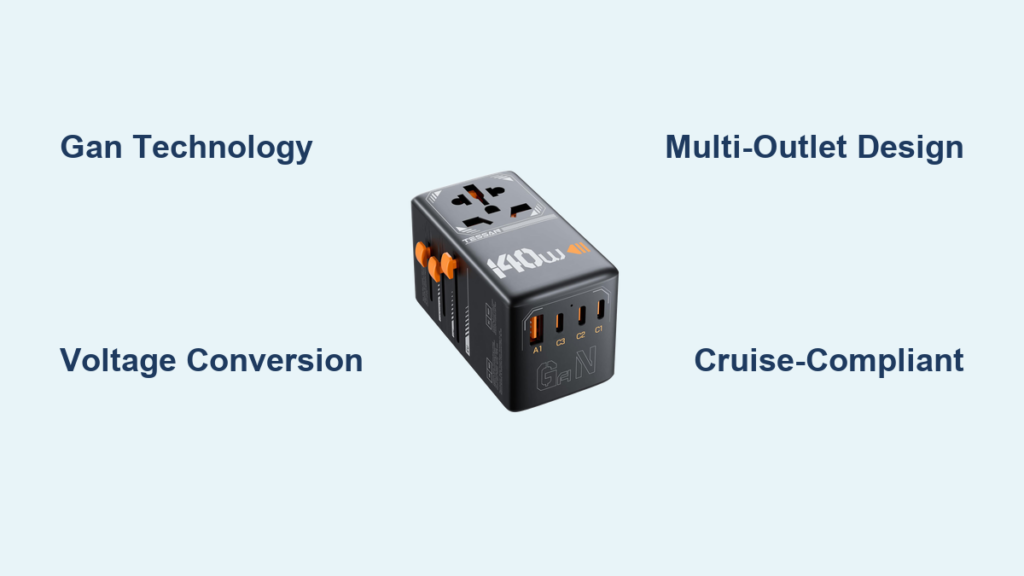
TESSAN Universal Converters: When Multi-Country Travel Demands Versatility
Frequent international travelers need solutions that work across multiple destinations without carrying separate converters for each region. TESSAN’s universal converters solve this pain point with intelligent design features that simplify global travel.
GaN Technology: The Game-Changer for Modern Travelers
TESSAN’s premium models incorporate Gallium Nitride (GaN) technology, which delivers significant advantages over traditional converters:
- 30% smaller size than silicon-based converters with equivalent power
- 40% less heat generation during operation, reducing fire risk
- Faster charging capabilities for compatible devices
- Higher efficiency that preserves battery health during charging
The TESSAN Universal Travel Adapter with GaN Fast Charging ($26.99) supports Type C, G, A, and I plug configurations while delivering 17W Power Delivery for optimal smartphone charging speeds. This single unit replaces multiple country-specific adapters, making it the best travel power converter for multi-destination itineraries.
Cruise Ship Power Solutions: Navigating Unique Restrictions
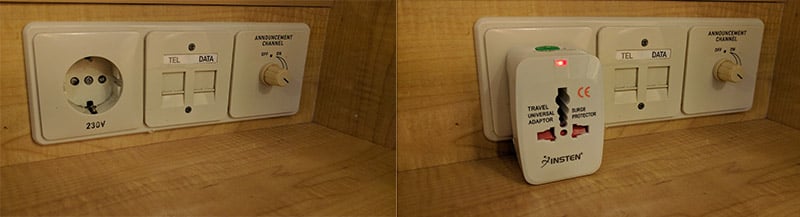
Cruise lines enforce strict electrical policies that standard converters often violate. Royal Caribbean and Carnival explicitly prohibit surge-protected power strips due to fire risks in shipboard environments—this includes many standard travel converters with built-in surge protection.
Cruise-Compliant Converter Features to Look For
When selecting a best travel power converter for cruise vacations:
- Verify non-surge protected design—essential for passing embarkation checks
- Opt for compact size—cruise cabins have extremely limited outlet space
- Choose models with multiple USB ports—reduces need for additional adapters
- Confirm compatibility with your cabin’s outlet types—most modern ships use standard US outlets
TESSAN offers specific cruise-compatible models that provide extra outlets without triggering security concerns, ensuring you can charge all devices in your cabin without violating ship regulations.
Critical Device Matching Mistakes That Damage Electronics

Most travelers unknowingly risk their devices by misunderstanding compatibility requirements. The single biggest mistake? Using a travel adapter instead of a true voltage converter for single-voltage appliances.
Step-by-Step Device Compatibility Checklist
Before plugging in any device abroad:
- Locate voltage specifications on the device or power adapter (look for “Input:” labels)
- Verify your destination country’s voltage standard (110-120V in North America, 220-240V elsewhere)
- Match specifications:
– If device shows “100-240V”—only needs plug adapter
– If device shows “120V only”—requires voltage converter - Check wattage requirements against converter capacity
- Confirm plug type compatibility with destination outlets
Warning: High-wattage appliances like hair dryers (typically 1200-1875W) require dedicated converters rated for at least 1600W. Most universal travel adapters cannot handle this load—TESSAN explicitly warns against using their adapters with hair dryers.
Smart Packing Strategies for Reliable Power Anywhere
The best travel power converter becomes useless if you don’t pack it strategically. Implement these professional packing techniques to ensure continuous power access:
- Carry a backup converter in your carry-on luggage—electronics fail when replacements are hardest to find
- Test all connections before departure—identify compatibility issues while solutions remain accessible
- Prioritize converters with multiple USB ports—reduces need for separate charging bricks
- Choose foldable plug designs—prevents outlet blockage and damage during transit
- Pack a small multi-outlet strip (where permitted)—maximizes limited hotel outlets
Pro Tip: For countries with unreliable power (like parts of Southeast Asia), select converters with built-in surge protection to guard against damaging voltage fluctuations—just avoid these on cruise ships where they’re prohibited.
The Final Verdict: What Makes the Best Travel Power Converter
Your ideal converter depends entirely on your specific travel patterns and device ecosystem. For multi-country business travelers carrying laptops and phones, a universal adapter like TESSAN’s GaN model provides the perfect blend of compatibility and charging speed. Families visiting Europe benefit from region-specific converters with multiple outlets for simultaneous device charging. Cruise passengers need specialized non-surge protected models that comply with ship regulations.
Key Takeaway: The best travel power converter isn’t about having the most features—it’s about having the right features for your specific journey. Prioritize safety certifications, verify device compatibility, and never assume your adapter converts voltage. With the right converter in your packing list, you’ll enjoy seamless power access that keeps you connected, productive, and safe throughout your international adventures.