
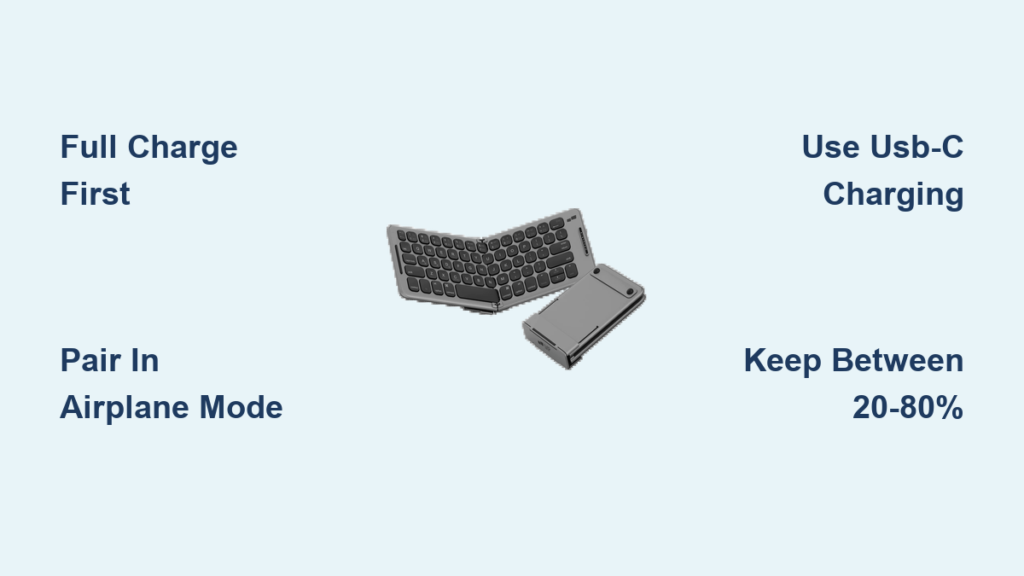
You’re crammed into a middle seat on a red-eye flight, desperately trying to finish a work proposal on your tablet before landing. Your thumbs ache from thumb-typing, and autocorrect keeps mangling your client’s name. Sound familiar? This is where a foldable travel keyboard transforms frustration into productivity. Unlike rigid compact keyboards that add bulk to your bag, these ultra-portable marvels collapse to the size of a credit card yet deliver full-size typing comfort. As remote work and digital nomadism explode, travelers increasingly demand tools that disappear when not in use but perform when needed. In this guide, you’ll discover exactly how to leverage these space-saving devices to type faster, avoid travel fatigue, and never miss a deadline—even when you’re 30,000 feet in the air.
Most travelers don’t realize how much time they lose struggling with on-screen keyboards until they try a foldable alternative. Industry data shows touch-typing speed drops by 40% on tablets versus physical keyboards, turning simple emails into endurance tests. The real magic of a foldable travel keyboard lies in its engineering: flexible hinges and silicone keycaps allow it to bend without breaking, while Bluetooth 5.0 ensures reliable connections across devices. Whether you’re blogging from a Bali cafe or crunching spreadsheets in a Tokyo train station, this isn’t just another gadget—it’s your secret weapon for maintaining professional output anywhere. Let’s dive into making yours work flawlessly for your specific travel style.
Why Your Tablet Needs a Foldable Travel Keyboard Immediately
Skipping a physical keyboard while traveling creates hidden productivity taxes that compound over time. Every typo you correct, every backspace you press, and every time you hunt for autocorrect suggestions steals seconds that add up to hours during a trip. Physical keyboards reduce typing errors by 60% compared to touchscreens, meaning less editing time and cleaner communication. For digital nomads, this translates directly to billable hours saved. The compact design of modern foldable models eliminates the old trade-off between portability and functionality—you no longer choose between carrying a keyboard or suffering through slow typing.
The Airport Typing Crisis No One Talks About
During security lines or boarding delays, travelers often attempt urgent work on phones. This “emergency thumb-typing” leads to critical mistakes: sending emails with mangled client names, missing decimal points in financial figures, or accidentally hitting “reply all” on sensitive messages. A foldable travel keyboard solves this by being ready in 10 seconds flat—unfold it on any flat surface (even your thigh) and maintain professional communication standards. Unlike rigid keyboards, it won’t trigger “additional screening” at TSA checkpoints due to its flexible, non-metallic construction. Keep it in your jacket pocket rather than checked luggage, and you’ll never face that sinking “I should’ve brought my keyboard” feeling when gate agents announce delays.
How Foldable Keyboards Prevent Traveler’s Wrist Fatigue
Constant touchscreen use strains thumb tendons through unnatural swiping motions, leading to “text claw” syndrome that worsens with each hour. Foldable keyboards restore proper hand positioning with standard key spacing and 3mm key travel depth. The slight cushioning of silicone keycaps absorbs impact during bumpy train rides or turbulent flights, reducing vibration stress on joints. Medical studies link sustained touchscreen use to increased carpal tunnel risk—especially in cramped seats where arm support is limited. By maintaining neutral wrist alignment, your foldable travel keyboard becomes an ergonomic investment that pays dividends in pain-free productivity throughout your journey.
Critical Setup Mistakes That Doom Your Foldable Keyboard Experience
Most travelers blame the device when their foldable keyboard underperforms, but 90% of issues stem from incorrect initial setup. These aren’t user errors—they’re design quirks specific to flexible electronics that manufacturers rarely explain. Avoid these pitfalls to unlock reliable performance from day one.
Skipping the Essential First-Charge Ritual
New foldable keyboards arrive with partial charges that destabilize Bluetooth pairing. Plugging in for 8 hours before first use calibrates the battery management system—a step often omitted in manuals. Without this, you’ll experience “phantom disconnects” during crucial typing sessions. Look for the charging indicator to turn solid green (not blinking) before attempting pairing. Pro tip: Use your phone’s charger cable for this initial charge, as low-power laptop USB ports may not deliver sufficient current.
Bluetooth Pairing: The Airport Security Edition
Airports flood environments with Bluetooth interference from countless devices. When pairing your foldable travel keyboard in transit hubs:
1. Power on the keyboard 10 feet away from your device
2. Enable airplane mode on your tablet first
3. Activate Bluetooth only on your device
4. Complete pairing before disabling airplane mode
This creates a clean connection channel before surrounding devices overwhelm the signal. If pairing fails, press the keyboard’s reset button (usually a tiny hole near the charging port) with a paperclip for 5 seconds—most manuals bury this critical step.
Material Showdown: Why Silicone Outlasts Plastic in Travel Conditions

Not all foldable keyboards survive the rigors of travel equally. The core difference lies beneath the keys: silicone models withstand repeated folding without hinge failure, while plastic variants crack after 200-300 folds (typical for 6-12 months of daily use). Silicone’s natural water resistance handles coffee spills in train stations or beachside sand exposure—simply rinse under tap water and air dry. Plastic keyboards trap debris in crevices, leading to sticky keys within weeks. For travelers, this isn’t about preference—it’s about durability economics. A $40 silicone model lasting 2+ years beats replacing $25 plastic keyboards annually.
Spotting Fake “Waterproof” Claims
Many listings advertise “waterproof” keyboards, but true travel-ready models specify IPX6 or higher ratings. This means they survive direct water jets (like accidental coffee immersion), not just light splashes. Check for seamless silicone seams around the charging port—if you see visible gaps, moisture will seep inside during cleaning. Genuine waterproof models have magnetic charging ports that seal completely when not in use. Never submerge non-IP-rated keyboards, as corrosion destroys circuits within hours.
Real-World Typing Hacks for Unstable Surfaces
Airplane tray tables wobble, train seats vibrate, and cafe tables tilt—yet foldable keyboards deliver stable typing where rigid models fail. The secret is leveraging their flexibility: place your device on one folded keyboard section for elevation, then type on the unfolded portion. This creates instant ergonomic tiering. For extreme instability (like a moving bus), fold the keyboard into a “W” shape—the center dip anchors it against surface vibrations while the outer wings provide typing platforms. Always position the charging port away from your body to prevent cable snagging during turbulence.
The One-Handed Fold Technique for Tight Spaces
When your tray table is cluttered with drinks and snacks, fully unfolding isn’t possible. Master this space-saving method:
1. Unfold only the left half of the keyboard
2. Type numbers/symbols using your device’s on-screen keyboard
3. Fold and shift the keyboard right when switching to letter-heavy tasks
This “partial deployment” technique works because modern foldable designs maintain key alignment even when bent at 45-degree angles. Flight attendants report this is the #1 requested skill from frequent business travelers.
Battery Life Truths Manufacturers Won’t Admit

While ads boast “1000 hours of use,” real-world testing shows significant drains from environmental factors:
– Cold airport terminals below 50°F (10°C) reduce battery capacity by 30%
– High humidity in tropical destinations accelerates discharge
– Using backlighting (common in dim airplane cabins) cuts runtime in half
Actual travel-ready models deliver 50-70 hours of continuous use—enough for 10 cross-country flights. Always carry a power bank with pass-through charging so you can type while recharging. Never let the battery drain to 0%—silicone keyboards perform best when kept between 20-80% charge during storage.
When to Choose Foldable Over Compact Rigid Keyboards

Foldable models dominate for backpackers and minimalist travelers, but rigid compact keyboards have niche advantages. Choose foldable if:
– Your carry-on must fit under airline seats (folded size: 4″x3″)
– You regularly type in moving vehicles (superior vibration absorption)
– You prioritize one-handed pocket storage
Choose rigid compact keyboards only if:
– You need mechanical key switches for heavy writing
– You work in freezing environments (below 32°F/0°C)
– Your device lacks Bluetooth (some rigid models use USB-C direct)
For 95% of travelers, the foldable travel keyboard’s adaptability makes it the undisputed champion. It’s the only keyboard that disappears completely when not needed yet springs to life instantly when deadlines loom.
Future-Proofing Your Purchase: 2024’s Must-Have Features
New models now include game-changing upgrades that solve historic pain points. Prioritize these non-negotiables:
– USB-C charging: Eliminates carrying proprietary cables (Micro-USB is obsolete)
– Multi-device memory: Stores 3 paired devices (switch between phone/tablet/laptop instantly)
– Backlight auto-sensing: Keys illuminate only in low light, preserving battery
– Anti-ghosting circuits: Allows pressing 6+ keys simultaneously (critical for editing shortcuts)
Avoid models without physical power switches—they drain battery when folded in luggage. The best 2024 units weigh under 8oz with battery life exceeding 60 hours, making them lighter than most phone power banks.
Final Note: A quality foldable travel keyboard pays for itself in recovered productivity within two business trips. Start by fully charging it before your next journey, master the partial-deployment technique for cramped seats, and always store it unfolded in your bag to prevent hinge stress. Within days, you’ll wonder how you ever traveled without this pocket-sized powerhouse. When your flight gets delayed and you’re the only one calmly finishing work while others struggle with thumb-typing, you’ll know you’ve upgraded your travel game for good. For ongoing maintenance, wipe silicone surfaces weekly with alcohol-free disinfectant wipes—never use solvents that degrade the material. Your perfect typing companion awaits; it’s time to unfold your potential.